



Why? Because so many people don’t understand it. Besides, this might help some new hires.
A few months back towards the end of summer and beginning of fall, I was out at a local drinking hole playing trivia. The question came up, “What does C.B.P. stand for?” Out of eight teams playing trivia, six got it wrong. It stands for Customs and Border Protection. Most of the wrong answers thought it was Customs and Border Patrol.
Thanks for reading! Subscribe for free to receive new posts and support my work.
I’ve seen people on Facebook writing “Way to go Boarder Patrol!” While the sentiment is appreciated, there is such a thing as a “boarder”, for instance, a snowboarder, or, someone who goes to boarding school.
I was recently talking with someone who knows a lot about immigration, but still the liberal propaganda was controlling the narrative, “Are they getting due process or not?” I was asked. Yes, yes, they are getting due process. They get more due process than you or I would.
I found myself having to describe the whole entire structure of the Department of Homeland Security as a result. Hang on tight because this might be a little boring. Grab some caffeine if you have to.
When I joined the Border Patrol, I had actually started the process of applying to be a Customs Inspector. However, one of the tests they were giving was scheduled at the same time I was having final exams for my graduate school. I picked graduate school over Customs Inspection. I had also applied to the Border Patrol and I had graduated by the time they responded. At the time, I didn’t know what I was getting into. I was quickly enlightened by the time I took the Border Patrol’s oral hiring boards that I was going to be running around in the field and not sitting at a booth waiting for cars to pull up to me.
Back then, late 90s, under the Department of Justice was the Immigration and Naturalization Service (I.N.S.). Under the I.N.S., there was the Border Patrol, Immigration Inspectors, Detention Enforcement Officers (jailers), Deportation Officers and I.N.S Special Agents on the enforcement side of things, and a separate wing that handled the actual issuing of green cards (what we called “Lappers” for Lawfully Approved for Permanent Residency). The enforcement wing and the naturalization wing of I.N.S. were often at odds over who should be legalized and who shouldn’t. As you might imagine, the law enforcement side tended to attract conservatives and the naturalization side tended to attract liberals.
Now, also working at the border were Customs Inspectors and Customs Special Agents. They were under the Department of Treasury. The Customs Inspectors had to know some immigration law when interviewing travellers, but they were mainly focused on contraband goods, and getting the taxes right on anything being imported into the United States. The Customs Special Agents were often going after imported drugs. I once knew a woman whose father had been a Customs Special Agent before transferring over to the Drug Enforcement Administration (D.E.A.) where he worked on the famous French Connection.
Anyway, something called 9/11 happened and it came out that several of the hijackers had overstayed visas and been otherwise illegally present in the United States. Famously, the liberals in the non-enforcement side of I.N.S. sent I-20 student status approval forms to a couple of the terrorists AFTER they had died in a fiery wreck, Mohamed Atta and Marwan Alshehhi.
For this reason and others, it was decided to form the Department of Homeland Security and incorporate a lot of things together. Instead of crossing the Hidalgo bridge from Tamaulipas into the United States not knowing if you would wind up talking to a Customs Inspector or an Immigration Inspector, those job titles were done away with. Now, they were to be called CBP Officers. To add to the confusion, they are sometimes called OFO Officers. “What does OFO stand for? Office of Field Operations. But, why is it called Office of ‘Field’ Operations? They don’t work in fields, the Border Patrol does!” There is/was a bit of a rivalry between CBP Officers and Border Patrol Agents. That being said, it’s easier to remember CBP/OFO as Booth Monkeys. Whether at an international bridge or an airport, they wear the blue uniforms, sit in booths, and ask you what the purpose of your visit is and if you have anything to declare.
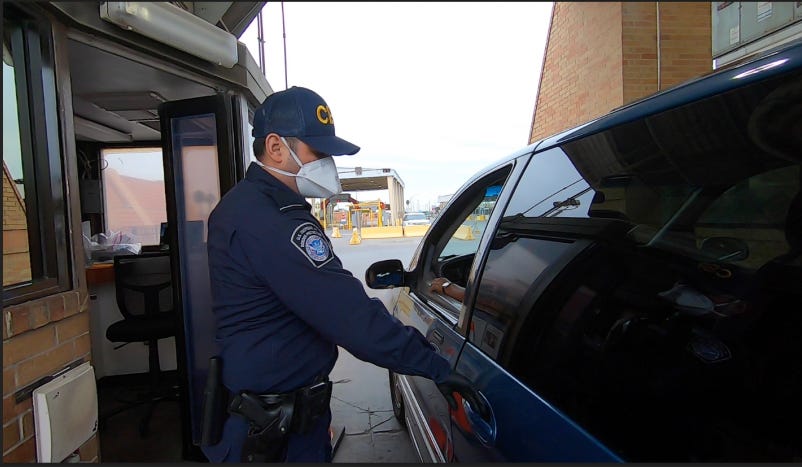
Above, a booth monkey working the vehicle traffic at the southern border. Notice there is no green grass like you would find in a field.
Meanwhile, the Border Patrol is out in an actual field, or, the woods, or, the desert, actually patrolling along usually in a Chevy Tahoe or Ford Expedition, but sometimes on horseback, ATV, etc…
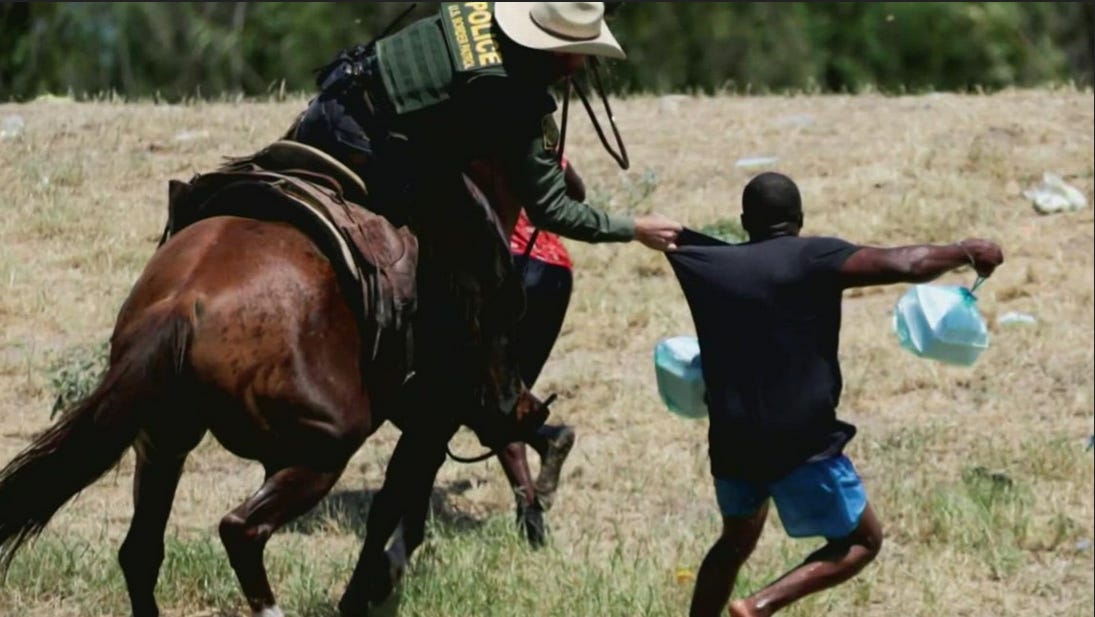
Above, USBP’s horse patrol sharing the love with a Haitian immivader. Notice the green grass like what you would find in a field.
Before I forget, the Border Patrol used to have its own boat patrol (it still does, but smaller) and the Customs service used to have a boat patrol too. The same with having Border Patrol pilots, and Customs pilots. Elements of these two agencies were combined to form CBP Air and Marine. The boat guys got the unfortunate title of Marine Interdiction Agents (M.I.A.s) which any military or history buff knows stands for Missing In Action. Because they do so much training, in my experience, they were often not around when we needed them. For anyone trying to get hired on to the Border Patrol, keep in mind that Marine Interdiction Agents and Air Interdiction Agents are being hired too. Please check it out before they close at the end of this month.
I digress slightly. When the Department of Homeland Security was formed, there were a bunch of outside agencies brought in under it; U.S. Coast Guard, Secret Service, FEMA, the TSA, and Cybersecurity & Infrastructure Security Agency (aka CISA, the ones who try to hide election fraud). The part of I.N.S. that handled legal immigration and naturalization became U.S. Citizenship and Immigration Services.
Now, let’s pretend that you join the U.S. Border Patrol as an “intern” (we were called trainees when I joined, and when they switched the name to intern, there were jokes about Monica Lewinsky brought up), who will you be dealing with? You might get to know some of the CBP Officers. I knew at least two couples where he was a Border Patrol Agent and she was a CBP Officer. Despite CBP Officers working primarily indoors or in outdoor booths, we sometimes did work together on things like outbound operations where we checked vehicles going into Canada as they left the United States.
As a Border Patrol Agent assigned to intel, I worked a lot with H.S.I. Special Agents. What are those? They are another name for ICE Special Agents. See, it turns out that when immigration became too controversial, the poor little dears who were ICE Special Agents wanted to be renamed to take the word “immigration” out of their title. They couldn’t just make themselves Customs Special Agents as that would make it appear the legacy Customs Special Agents dominated the legacy I.N.S. Special Agents. So, they settled on Homeland Security Investigations Special Agents. Check out the pamphlet below to further sow confusion:
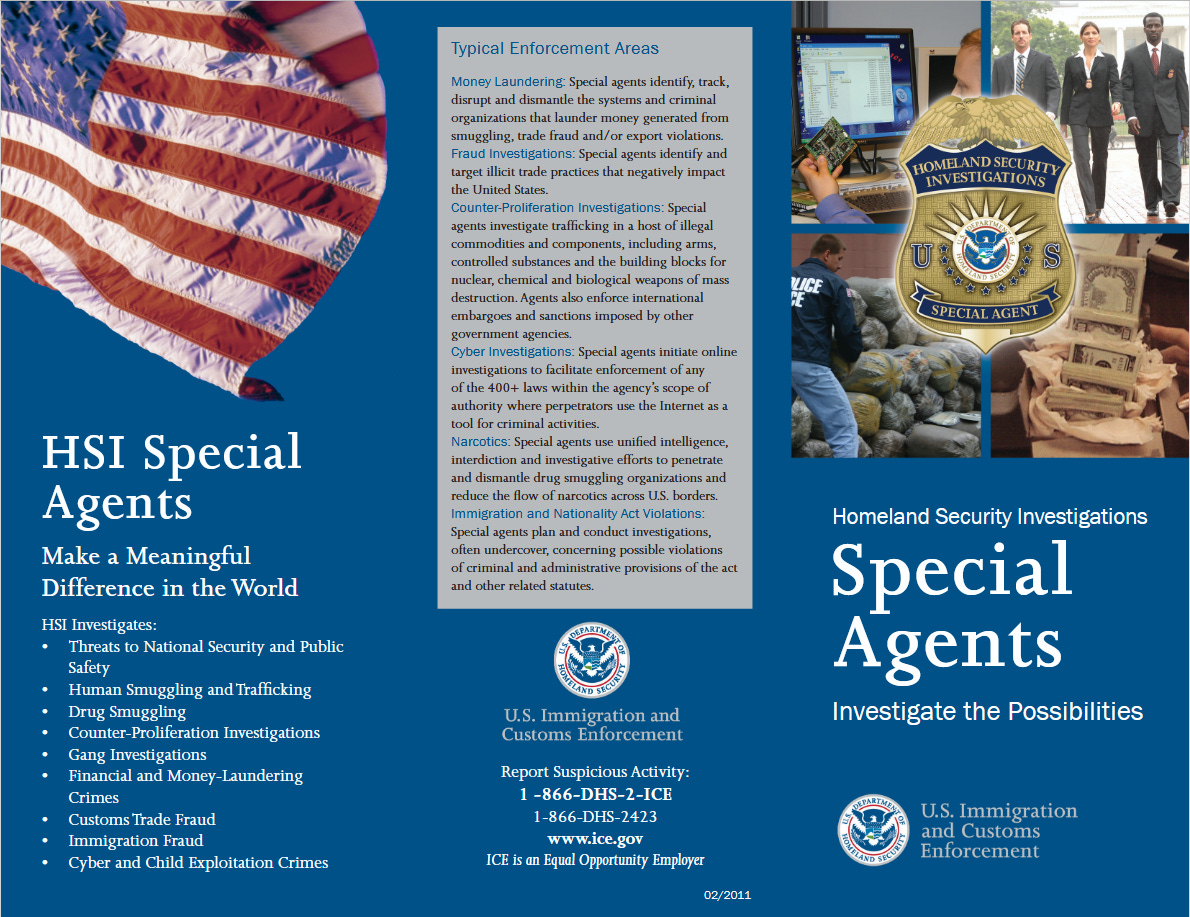
(Slightly amusing story. When Hurricane Katrina happened and they sent Border Patrol and ICE Special Agents to New Orleans to help out with law enforcement, the locals ran after the Special Agents because they thought they were giving out ICE).
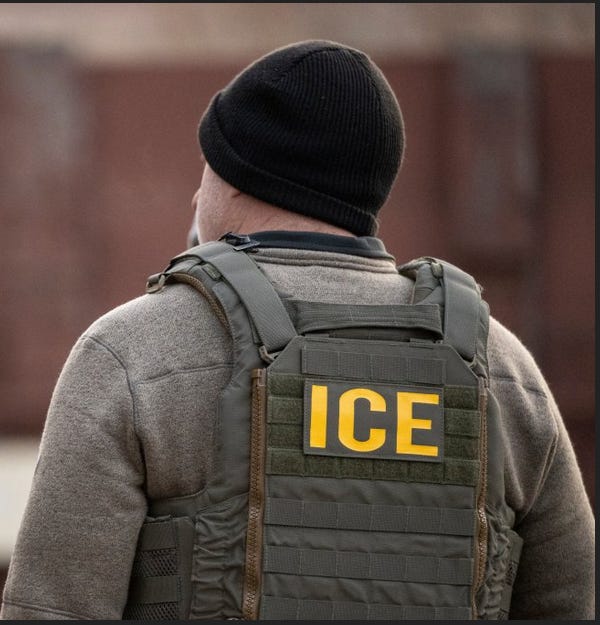
They may call themselves H.S.I. and put that on their badges, but most people still refer to them as being part of I.C.E.
Also, as a rookie Border Patrol Agent, you may deal with Deportation Officers. Most likely, you will be calling them on the phone to make sure they have bed space for whoever you arrested since they run the immigration detention facilities. However, Deportation Officers do run around trying to catch fugitive illegal aliens too. Years ago, when I was trying to get out of Maine, I applied for a position as an Immigration Enforcement Agent, a position that no longer exists. Once Immigration and Customs Enforcement decided it was cheaper to privatize the detention facilities, they upgraded all the I.E.A.s to Deportation Officers. This was a pay increase and something of an increase in prestige too. Now, they got to run around and sack people up. To increase confusion, Deportation Officers are also part of Enforcement and Removal Operations (E.R.O.).
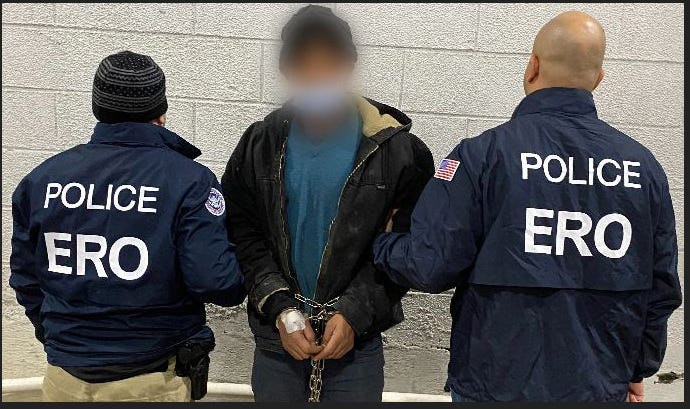
But frankly, being called a Deportation Officer is way cooler. Yes, they are hiring too, and should not be confused with H.S.I. Special Agents. If you have not done so, consider applying to them before it expires.
When you see a viral video of ICE picking up illegal aliens at the court house, that’s actually ERO waiting to see if they get ordered deported by the immigration judge. If the answer is “Yes”, ICE ERO is sacking them up much to the aggravation of their traitorous open borders/destroy America attorneys. They can file an appeal, but now they have to do so from within custody. This keeps them from fleeing (much to the aggravation of their lawyers). That’s why the propaganda media is yelling, “They (the illegal aliens) are not getting due process.” Well, actually, they are. They’re just not able to hide from immigration enforcement as easily.
Illegal aliens who claim asylum get a first hearing before an asylum officer, but all the asylum officer does is taking down their second story (their first story is the lie they told the CBP Officer or Border Patrol Agent before they got coached by one of the NGOs on what to say), and determine from that whether or not they should be released from custody. I wrote a bit about it here. Afterwards, if the illegal alien bothers to show up for immigration court and gets ordered deported, they can appeal it to the Executive Officer for Immigration Review (EOIR). If the alien fails there, they can appeal it again to a federal court. If the federal court rules against you, you can appeal it to an appeals court, and if that fails, you can appeal it to the Supreme Court. So, yes, the illegal aliens are getting due process, and lots of it. In a way, they are getting more than a United States citizen would since if you or I commit a federal crime, we go to federal court and, if found guilty, we can only appeal it to federal appeals court and then the Supreme Court.
Thanks for reading! Subscribe for free to receive new posts and support my work.

20 year veteran of the U.S. Border Patrol. Author of "What Bridge Do You Work At? Or, Kids Are Cute; Therefore, Open Borders" & "East into the Sunset: Memories of patrolling in the Rio Grande Valley at the turn of the century". Books are available at Amazon, Barnes and Noble, as well as Thrift Books.
Master's Degree in Justice, Law and Society from American University.
Grew up partly in Europe.