

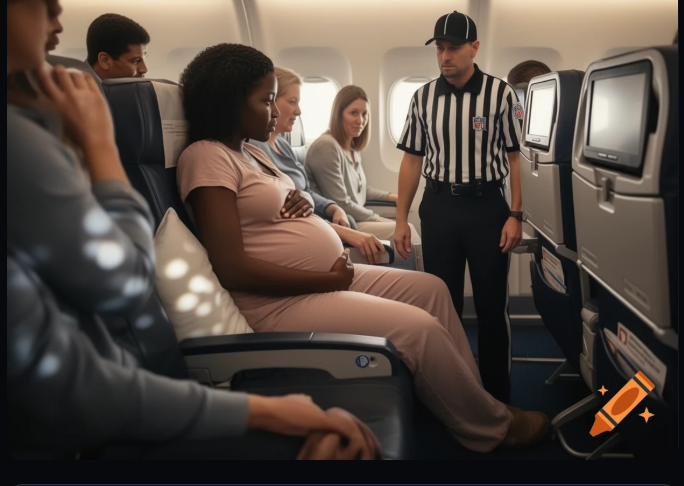
This is more for my records than anything else, some good reference articles. I used Craiyon AI image generator for the picture. I couldn’t get it to have the referee place a whistle in his mouth as if about to make a close call).
In my previous article, “The Fight Over Birthright”, I somewhat facetiously said it was everything you wanted to know about birthright citizenship, but were afraid to ask. Of course, I’m not really a lawyer or a historian, so, even though there was a lot of good information, I have since discovered some other articles that give a lot more information on the subject, all of which I believe point to how birthright citizenship should be struck down (not that it will be). However, if it is not, I think this should discredit the court every bit as much as the decision in the Dred Scott case did.
The first article is from The Federalist. Apparently, a baby was born on a plane headed from Jamaica to New York City. As of current interpretation of birth right citizenship, the baby could be considered a US citizen if the baby was delivered within 12 nautical miles of the U.S. mainland. Perhaps, we should have some referees on flights and instant replay to see if the baby came early or not. “Hold it in honey, hold it in! The flight map has us 20 miles out and closing fast!” Get ready for the instant replay. The full sentence everyone is battling over is “All persons born or naturalized in the United States, and subject to the jurisdiction thereof, are citizens of the United States and the State wherein they reside.” So, as the author points out, everyone is focused on “…and subject to the jurisdiction thereof…” and not on the “and the State wherein they reside.” Since the writers of the 14th Amendment were focused on not just newly freed slaves, but also free black people, there was an assumption in their world view that they would be residing in the state, not returning to China after the birth (or whatever country).
Keep in mind that the Slaughterhouse Cases (1873) made sure everyone knew that the Privileges and Immunity clause of the 14th Amendment was meant for newly freed slaves, and not for anyone else.
====
The next article comes from the American Thinker “What’s Wrong With Wong Kim Ark?” (It sort of reminds me of the Australian joke that “Two Wongs don’t make a white”).
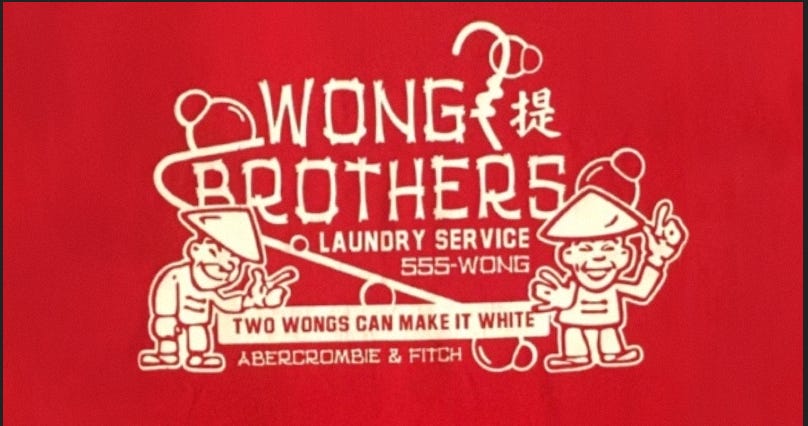
Above, a variation on that from Abercrombie & Fitch that they supposedly really did sell.
The whole article is worth a read, I’ll try to summarize. There was no such thing as a greencard back in 1898. So, Wong Kim Ark’s parents were still under the jurisdiction of China. (I would add the Wong Kim Ark dressed in traditional Chinese clothing his entire life and moved back to China and the end of his life. He truly thought himself Chinese).
Remember that the Civil Rights Act of 1866 said that you had to be born in the United States “…and not subject to any foreign power”.
=====
The next article also comes from Button Gwinnett of American Thinker; “Congress Has Established That People Here Illegally Are Not Resident”. I’ll just give one quote here, “The Constitution assigns no authority whatsoever to the Supreme Court to decide what constitutes permanent residence in the US or who qualifies as a permanent resident. Only Congress has that authority. An honest court must be compelled to accept Congress’s definition of “resident.” In today’s legal environment, any alien present in the United States without a permanent resident card is either a visitor or an invader and is ineligible to give birth to US-citizen children.”
====
Finally, I find this article again from American Thinker possibly the most fascinating. “What ‘subject to the jurisdiction thereof’ really meant” by Larry Moore. Being that I’m a history buff, I like the context that he puts things in. I’m just going to quote from several passages. In reference to what the “jurisdiction thereof” meant he points out:
“To understand what that phrase meant, we must revisit a part of American history that is often overlooked if not outright hidden. The conventional narrative portrays the Civil War–era North as uniformly noble and anti-slavery. And it is true that many Northern states abolished slavery well before the Civil War. But now, the rest of the story.
After ending slavery, several Northern states enacted laws that made it extremely difficult, if not impossible, for free black people to remain within their borders. These laws required proof of freedom; registration with authorities; and, in some cases, the posting of substantial financial bonds.
Consider Ohio. After abolishing slavery, it required free black individuals entering the state to present proof of freedom, something a runaway slave could not produce, and they had to post a bond, typically $500. In today’s terms, that is roughly $14,000. For a family of six, that would amount to approximately $84,000. The practical effect was obvious: Most newly freed individuals could not afford to stay.”
He goes on: “Other states followed similar paths. Indiana imposed registration and bonding requirements and ultimately prohibited black immigration altogether. Illinois required proof of freedom and later barred black settlement entirely. Iowa imposed bond requirements. Oregon enacted laws ordering free black residents to leave and prohibiting future settlement. Michigan required registration and bonding.”
Frankly, it makes the interpretation of the 14th Amendment’s “…And the States wherein they reside” all the more important. It’s also interesting to note this was not just aimed at newly freed slaves, but black people in the north too. (I also find it interesting that Oregon essentially banned black people outright. Was it because they saw the problems caused by slavery and they just didn’t want to deal with the mess of runaway slaves? What was their logic?)

20 year veteran of the U.S. Border Patrol. Author of "What Bridge Do You Work At? Or, Kids Are Cute; Therefore, Open Borders" & "East into the Sunset: Memories of patrolling in the Rio Grande Valley at the turn of the century". Books are available at Amazon, Barnes and Noble, as well as Thrift Books.
Master's Degree in Justice, Law and Society from American University.
Grew up partly in Europe.