

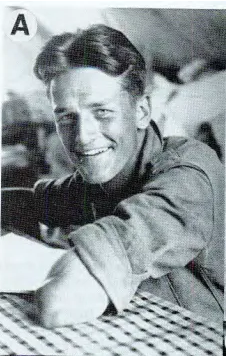
Of all my relatives, the one who I thought would have a Wikipedia entry on him (or her) was my uncle Charlie. Sadly, he does not, although, a word he invented actually is, Cactolith. Charles Butler Hunt was a geologist with a bit of a sense of humor and he was making fun of the geologists’ tendency to make up words to try to describe the “infinite variety of shapes intrusions can form.” So, he saw a formation he thought looked like a cactus, and named it after that.
I knew him all my life as Uncle Charlie. He had married my grandmother’s sister, Alice. So, it was always Alice and Charlie. They supposedly met on a blind date. He had been going to Colgate and started graduate school at Yale. I believe she was attending Vassar. I remember some story about his going to visit her and, in those days, since it was strictly verboten for men to be on campus, he slept overnight in a nearby graveyard. As a toddler hearing that, I thought he was incredibly brave.
Charlie got hired on to the U.S. Geologic Survey in 1927. He did field work with them while still attending Yale. In 1929, he was out in the hinterland of Moab, Utah, and Alice was in a different world in New York City. He writes about going into the town of Crescent Junction, “…Crossing arroyos along that muddy highway in those days could be an experience. Alice, my fiancee, was in New York working at a brokerage house. That fall, the financial crash occurred, but it really wasn’t her fault.” They were married in 1930 in New Mexico at a Catholic shrine despite neither of them being Catholic with no family in attendance.
Uncle Charlie had been a professor of Geology at Johns Hopkins University. He wound up writing quite a few articles and books. One of them became a standard textbook for teaching Geology around the country. I’m not sure which of his books it was. It could have been “Geology of Soils: An Introduction to the Ground Around Us”, or, “Physiography of the United States”, or, maybe both or neither. (It may also have been “Natural Regions of the United States and Canada” or all three).
If you wish a longer biography of his, you can read it here. As a kid, I was told (erroneously) that he mapped Death Valley by mule back. He didn’t map Death Valley from what I could ascertain, but he did do a lot of the mapping of the Henry Mountains by mule back. Later, he was to do field work in Death Valley and wrote a book on it. Supposedly, the Henry Mountains expedition was one of the last, if not the last mule trains that the U.S. Geologic Survey used.
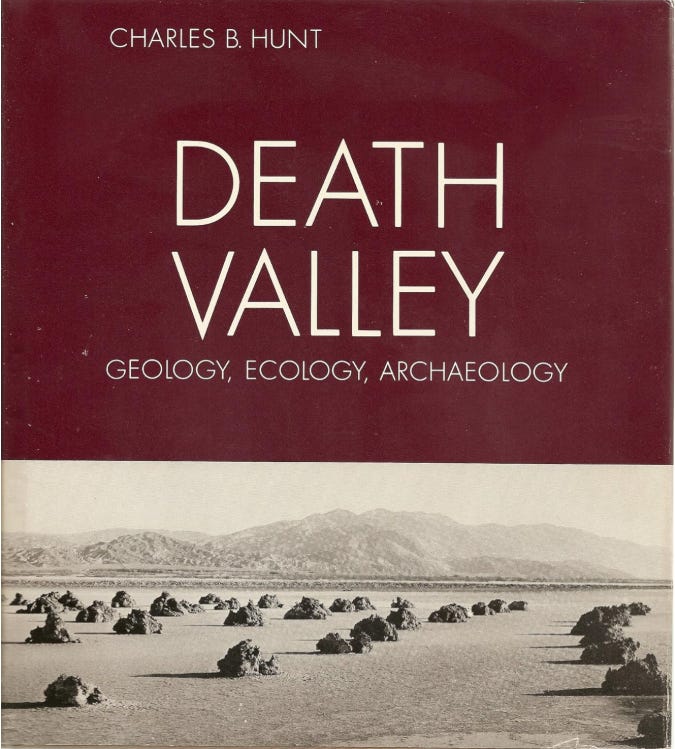
Charlie Hunt’s father was Irvin L. Hunt, a Professor of Law & History at West Point. From West Point, he was transferred to the Philippines. While Charlie was there, apparently, there were a few earthquakes and he could remember his mother’s swinging orchid plants. A search of Brave AI tells me that the Philippines average 14,000 earthquakes per year. Of course, most of them are very minor, and you cannot feel them, but some are very intense. I wonder if that made him more interested in geology. Geology seems rather dull and boring with not much happening, but if you are in an area with earthquakes happening all the time, it sort of changes the perspective. Geology in action.
Somewhere, buried in his files, I remember reading that Charlie said he got interested in geology because he was interested in eternity. I remember him telling me that his father had been a historian and he initially wanted to be one too, but it didn’t go far enough back for him. So then, he wanted to be an archeologist, but he found that didn’t go back far enough in time for him either. He wound up on geology precisely because it does go back so far.
He started his career doing horse back treks through Utah, New Mexico, Montana and other remote places exploring, mapping and making notes on the geology of the American west. He wrote about some of it here in an article titled, “Around the Henry Mountains with Charlie Hanks, Some Recollections”. Charlie Hunt tells about a senior mountain guide the U.S. Geological Survey hired named Charlie Hanks (two Charlies to make it confusing). I’ll steal some pictures from them and hope the U.S. Geological Survey isn’t offended.
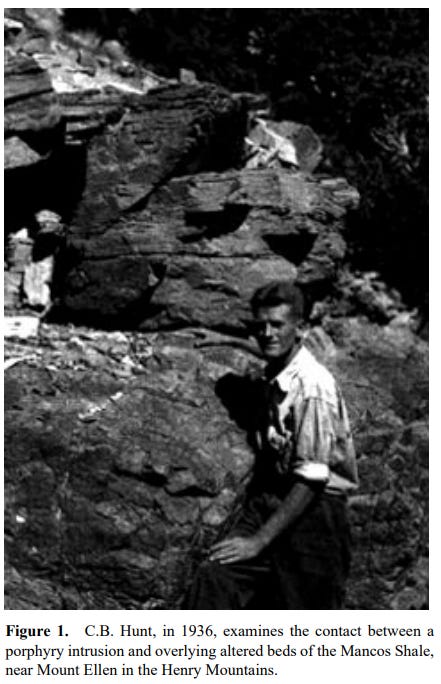
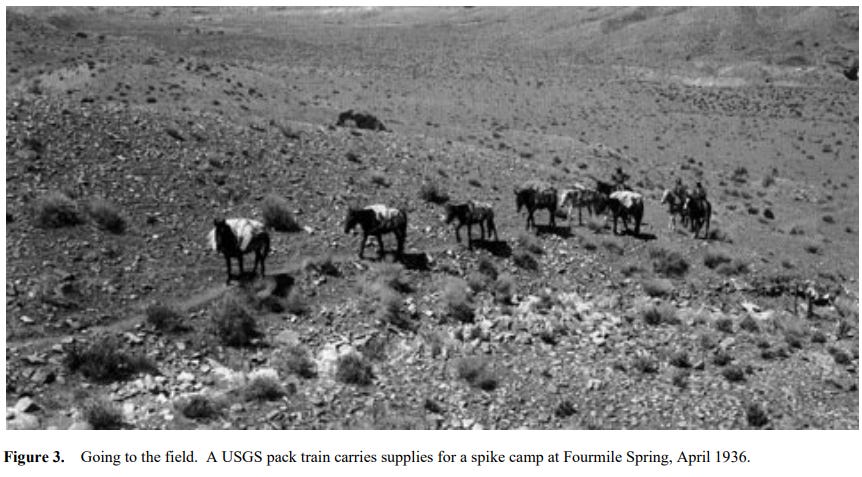
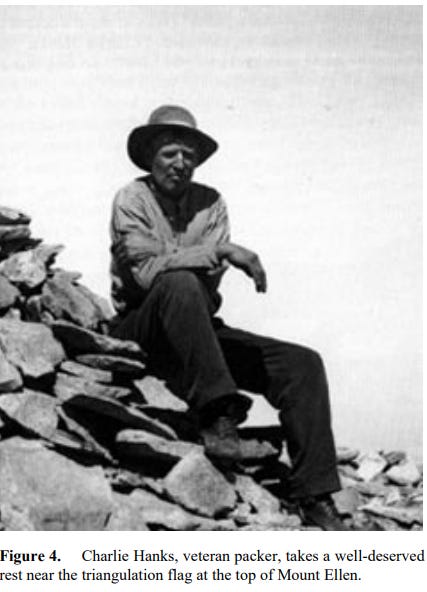
He tells amusing stories about being out in the wilderness, like how one of the horses wandered off and got lost in the night. Hanks took off in the morning with one of the mules and was back by midafternoon with the horse. The young geologist marveled at how he was able to find the horse in the vastness. Hanks said he just thought like what a horse would do. In this case, the horse was headed to their previous camp site.
Another time, well, I’ll just cut and paste the story:
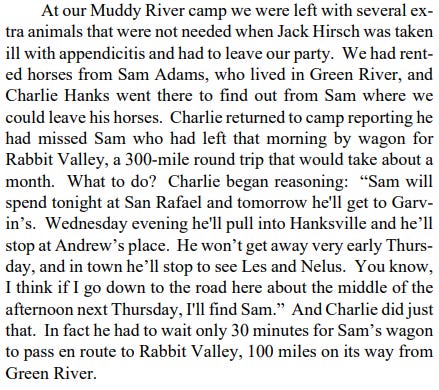
To the kids of today, they may not get it. However, I’ve lost friends (not permanently) over not being able to find them at ski resorts in the days before cell phones. Hell, even with cell phones, due to the poor reception from one mountain to the next, I’ve not been able to contact friends. The ability to sit down and figure out where someone else is going to be using knowledge of the person, who they were friends with and what their habits were etc… is pretty remarkable. It’s almost a feat a “mentalist” would pull off.
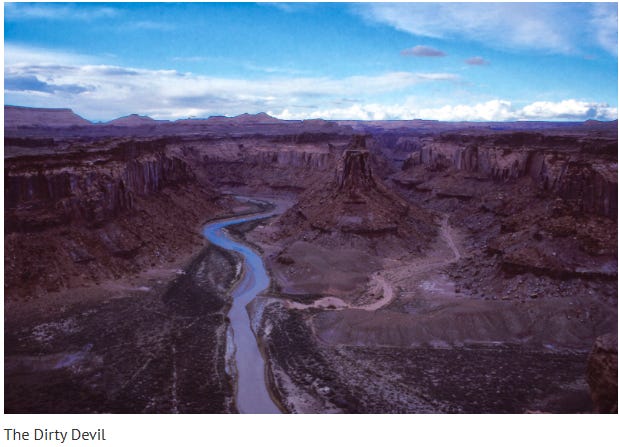
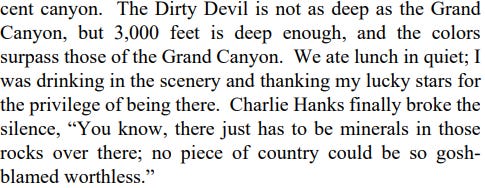
Charlie Hunt had other amusing stories like how he was told one river was named the Dirty Devil. It was named that by John Wesley Powell when he was going down the Colorado River and had to contend with a tributary that was not the trout stream he had hoped. The Board of Geographic names asked what the locals called it, and the U.S. Post Office in 1890 said they called it the “Fremont”. Charlie Hunt went to the local Post Office in person and asked what the locals called the river:
“Charlie Hanks referred to the river as Dirty Devil and so did everyone else in Hanksville. I was anxious to restore the original name because of its historical flavor. Knowing the Board on Geographic Names would consult the Hanksville Post Office, then managed by Mrs. MacDougal. I asked her the name of the river. She replied, ‘Oh you mean the Dirty Devil?’ I then told her that her predecessor had said that the nicer people call it Fremont. She only smiled, and said, ‘Oh, the nicer people moved away from Hanksville a long time ago.’”
The locals had other amusing names like a usual dry wash near Mount Hillers they called the “Shitimaring”. Because they couldn’t put that on a US. Geological Survey map, they called it the Shootaring instead. (Brave AI tells me that there is a place called the Shootaring Canyon Uranium Mill).
To be continued…
20 year veteran of the U.S. Border Patrol. Author of "What Bridge Do You Work At? Or, Kids Are Cute; Therefore, Open Borders" & "East into the Sunset: Memories of patrolling in the Rio Grande Valley at the turn of the century". Books are available at Amazon, Barnes and Noble, as well as Thrift Books.
Master's Degree in Justice, Law and Society from American University.
Grew up partly in Europe.