

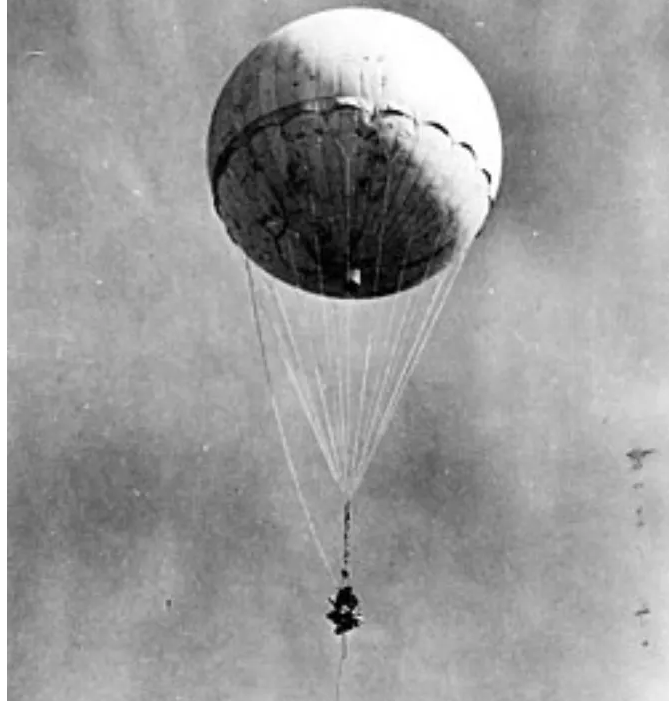
Above, a re-inflated Japanese Fu-Go Bomb.
On May 5, 1945, Reverend Archie Mitchell drove his wife and Sunday school students to Fremont National Forest in Oregon for a picnic. While Archie was parking the car, his wife, Elsie (who was pregnant) and the kids discovered a balloon on the ground. Different accounts say that Archie Mitchell was getting lunch out of the car, or, parking it. Archie supposedly yelled for them to not go near it. Moments after, a bomb went off killing all of them. From Wikipedia, “As I got out of my car to bring the lunch, the others were not far away and called to me they had found something that looked like a balloon. I had heard of Japanese balloons so I shouted a warning not to touch it. But just then there was a big explosion. I ran up there — and they were all dead.”
(Mitchell himself was a tragic figure who would later go to Vietnam in 1962 to help lepers, only to get kidnapped by the Vietcong and never seen again).
The Japanese had been angry at Doolittle’s Raid on Tokyo. They wanted revenge. How to strike back against the United States that was so far away? They came up the idea of sending balloons over the United States to set forest fires. The Japanese sent an estimated 9,300 balloons to the United States. They landed in Canada, California, Oregon, Washington state and even states much farther east. Fortunately for us, it had been an unusually wet winter from 1944 into 1945 and that (along with Mayor Karen Bass not yet being in charge of Los Angeles) prevented terrible fires breaking out all over the west coast. Some of the balloons fell into the Pacific, and a few were shot down by our planes:
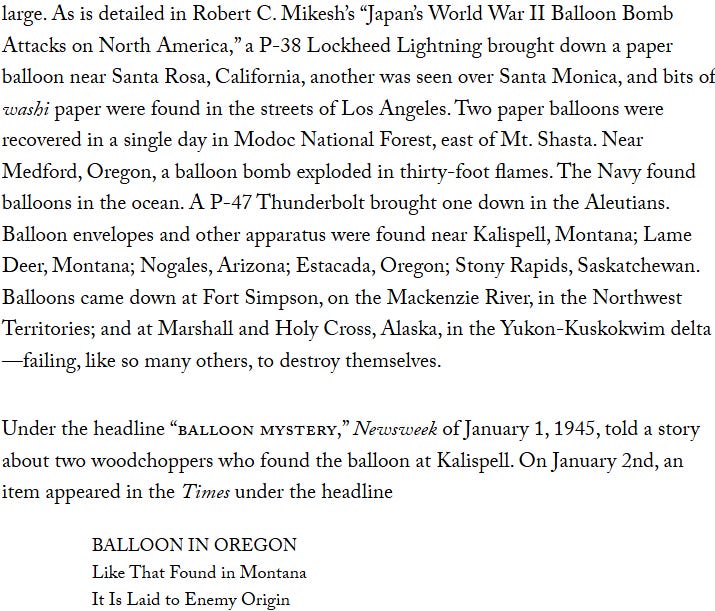
Above, an excerpt from The New Yorker on the balloon bombs. “The Gravel Page; The most frightening crimes have no witnesses except the ground on which they were committed. And from that alone forensic geologists illuminate cases in a way that would impress Sherlock Holmes, the sciences’ first practitioner”, by John McPhee, 1996.
How to figure out where precisely the bombs were coming from and how to stop them? The military put a blackout on reporting about the bombs so as not to panic the public. Initially speculation was that the Japanese were sending them from submarines. The Japanese had discovered the jet stream in the 1920s, but only recently decided it could be used to their advantage.
It sort of makes you wonder if the Chinese hadn’t read about this when they sent their spy balloons over the United States during the Biden administration.
The army came to the Military Geology Unit with small cup size samples of sand wanting to know from where it came. They didn’t tell the Unit where it had been found. The Japanese were using sandbags as ballast from the balloons and that is where the sand samples came.
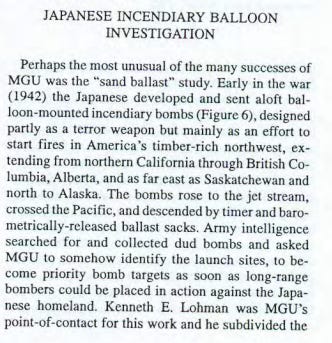
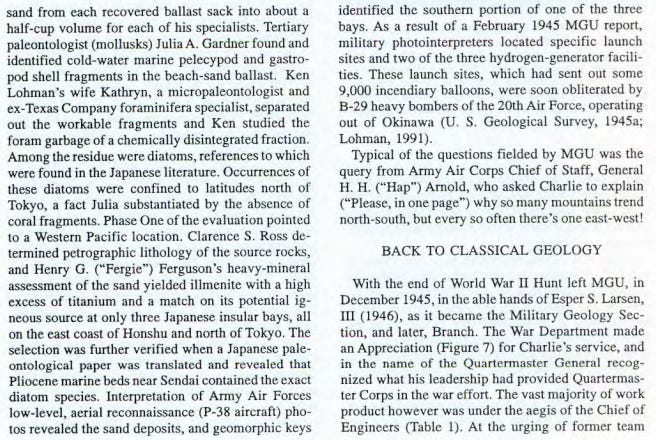
Above, more from the Bulletin of the Association of Engineering Geologists, “Biography of Charles Butler Hunt, Geologist”. I linked to it previously, but here it is again.
I’m not going to pretend like I know what exactly a “foraminifera specialist” does, or a “micropaleontologist”, but I’m glad they exist because they were able to identify the beaches from where the sand had been collected. From there, air reconnaissance identified a likely hydrogen making plant. They bombed the plant and no more balloons came across from Japan.
The Brits had taken over the European Theater, and that had left the U.S. free to go after the Pacific Theater. Charlie writes that in the Battle of Leyte (Philippines) the geologists did their geology while under fire.
20 year veteran of the U.S. Border Patrol. Author of "What Bridge Do You Work At? Or, Kids Are Cute; Therefore, Open Borders" & "East into the Sunset: Memories of patrolling in the Rio Grande Valley at the turn of the century". Books are available at Amazon, Barnes and Noble, as well as Thrift Books.
Master's Degree in Justice, Law and Society from American University.
Grew up partly in Europe.